Sinking Funds: How to Stop Annual Bills Becoming Emergencies
Put aside a little each month for the costs you know are coming — Christmas, the MOT, insurance renewals — with 12 UK sinking funds, a worked £300-a-month example and a Google Sheets tracker.
Templates for this
A sinking fund is money you put aside every month for a cost you know is coming, so that when the bill arrives it is already paid for. Christmas, the car insurance renewal, the MOT, a holiday, a boiler service — none of them are surprises, but each one feels like an emergency if you have nothing set aside when it lands.
The monthly amount is simple arithmetic:
Monthly amount = (what it will cost − what you have already saved) ÷ months until it is due.
A £600 Christmas, started in January, is £50 a month. Started in October, it is £200 a month. Sinking funds work because they start early.
What is a sinking fund, and how is it different from an emergency fund?
Both are savings, but they do opposite jobs. A sinking fund pays for something you know is coming. An emergency fund covers what you cannot predict.
| Sinking fund | Emergency fund | |
|---|---|---|
| For | Known, irregular costs — Christmas, insurance renewals, the MOT | Genuine surprises — job loss, a broken boiler, an urgent repair |
| Amount | The cost of the thing | Usually 3–6 months of essential spending |
| When it is spent | On a date you can name | Only when something goes wrong |
| After it is spent | Starts again for next time | Refilled as quickly as possible |
Without sinking funds, the emergency fund ends up paying for Christmas, and then there is nothing left when a real emergency happens. Keeping them separate is what makes both work.
12 sinking funds every UK household should consider
Not every household needs all of these — but most people are caught out by at least three.
- Christmas and gifts — presents, food, travel. The single most common cost people forget to plan for, despite knowing the date.
- Birthdays and occasions — family birthdays, weddings, hen and stag weekends, leaving collections.
- Holidays — flights and accommodation are usually paid months before you go.
- Car insurance — paying annually is usually cheaper than monthly instalments, which carry interest. A sinking fund makes paying annually possible.
- MOT, servicing and repairs — the MOT is yearly once a car is three years old, and the service usually comes with it.
- Vehicle tax — paid annually or in instalments; annual is simplest to plan for.
- Home and contents insurance — another annual renewal that is cheaper paid in one go.
- TV licence — a fixed yearly cost if you watch live TV or use BBC iPlayer.
- Boiler service and home maintenance — the annual service, plus the smaller repairs every home needs.
- Dentist, opticians and prescriptions — check-ups, new glasses, and anything not covered by the NHS.
- Pets — vet visits, vaccinations, insurance excesses, boarding while you are away.
- Annual subscriptions and renewals — Amazon Prime, software, memberships, domain names, the gym if you pay yearly.
Others worth a thought: school uniforms and trips, replacing a phone or laptop, and a "car replacement" fund if you will need another car in a few years.
A worked example: £300 a month covers £3,600 of annual costs
Here is a realistic household's sinking funds, each with a 12-month horizon:
| Sinking fund | Cost per year | Monthly amount |
|---|---|---|
| Christmas | £600 | £50 |
| Car insurance | £540 | £45 |
| MOT, service and repairs | £240 | £20 |
| Holiday | £1,200 | £100 |
| Birthdays and occasions | £300 | £25 |
| Home and contents insurance | £240 | £20 |
| Boiler service and home repairs | £360 | £30 |
| Annual subscriptions | £120 | £10 |
| Total | £3,600 | £300 |
£3,600 a year is £300 a month. Without sinking funds, that same £3,600 still has to be paid — it just arrives as a series of £240, £540 and £1,200 shocks instead of one steady line in the budget.
How to set up sinking funds, step by step
- List every irregular cost from the last 12 months. Go through your bank statements month by month — Christmas, renewals, the MOT, birthdays. Anything that is not a regular monthly bill goes on the list.
- Put a cost and a due date against each one. Use last year's figure, rounded up a little for price rises.
- Work out the monthly amount with the formula: (cost − already saved) ÷ months until due.
- Add the monthly amounts together. This total is one line in your budget, the same as rent or council tax.
- Open somewhere separate to keep the money — a savings account or your bank's pots (more on this below).
- Pay in on payday, automatically. A standing order the day after your salary lands means the money is gone before you can spend it.
- Spend from the fund when the bill arrives, then restart it for next year.
If the total feels too high, that is useful information rather than failure: it is what your life already costs. Trim the funds you have most control over — holidays, gifts — rather than skipping the ones you cannot avoid, like insurance.
Where to keep sinking funds in the UK
The money needs to be safe, separate and easy to reach — this is short-term saving, not investing.
- Bank "pots" or "spaces". Monzo, Starling and several other UK banks let you split savings into named pots inside one account. One pot per sinking fund makes it obvious what each pound is for.
- An easy-access savings account. Pays interest and keeps the money out of your current account. Some people keep one account for all sinking funds and track the split in a spreadsheet.
- Not in investments. Sinking funds are spent within months. Stock market investments can fall in value at exactly the wrong time; cash savings cannot.
Check that the account is protected by the Financial Services Compensation Scheme (FSCS), which covers savings up to a limit per person, per banking group, if the bank fails.
Tracking sinking funds in Google Sheets
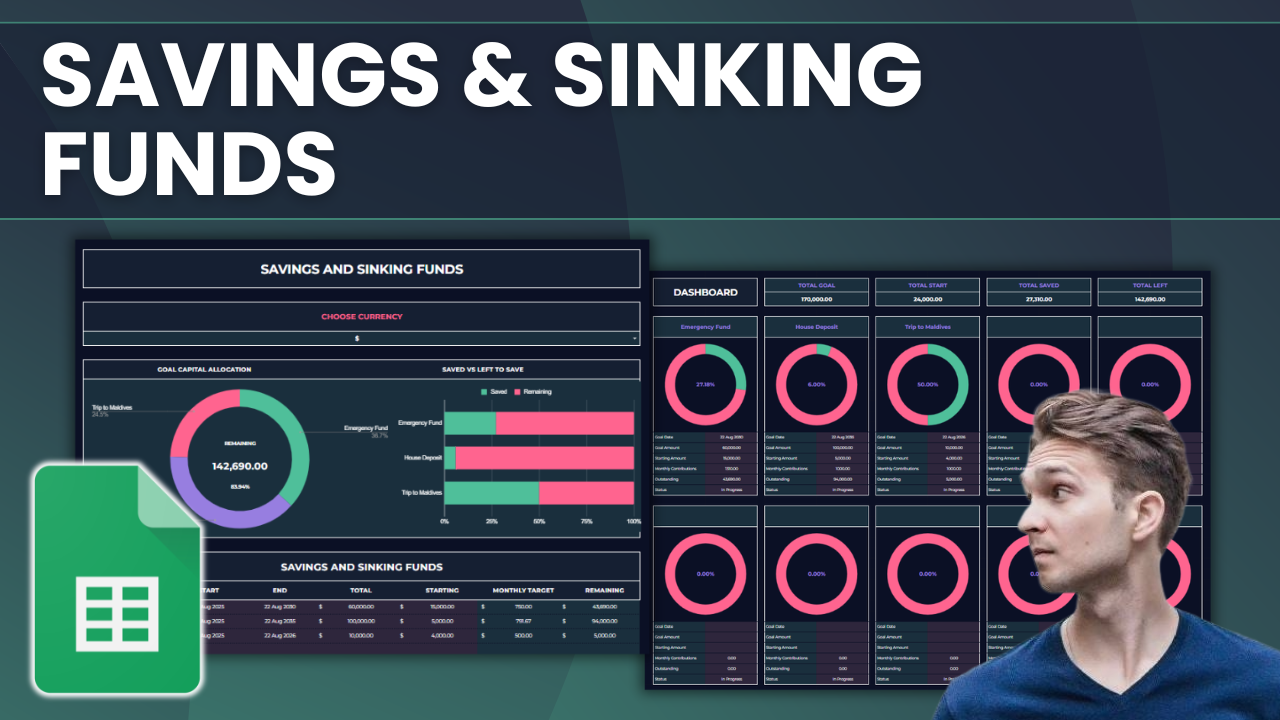
Pots show balances, but not whether you are on track: if the holiday is in four months, is the pot where it should be? A spreadsheet answers that. The Savings Goal & Sinking Funds Tracker is built around the formula above:
- Each sinking fund is a goal with a target amount, a start date, an end date and whatever you have already saved. The sheet works out the monthly target and the amount remaining for you.
- A contribution log records each payment by date, description, goal and amount. As you add contributions, the remaining amount and monthly target update — so if you miss a month, the sheet shows what it now takes to catch up.
- A dashboard totals every goal — total target, starting amounts, total saved and total left — with a progress ring and status for each fund, and a chart of saved against left to save.
- Any currency — choose it from a drop-down.
It is a one-off £2.50 purchase, works in Google Sheets on your own Google account, and has no subscription.
If you plan your whole month with zero-based budgeting, sinking funds slot in as one line — every pound gets a job, and part of that job is next December.
Common mistakes
- Using the emergency fund for predictable costs. If Christmas comes out of the emergency fund, the emergency fund is a sinking fund with a misleading name.
- Forgetting price rises. Insurance renewals especially tend to rise; round the target up.
- Too many funds to manage. Start with the three costs that caught you out last year, then add more once those are running.
- Raiding one fund for another. Moving money from holidays to cover a car repair is fine — as long as you decide it deliberately and adjust the holiday plan, rather than finding out later.
- Not restarting after spending. The fund that paid this year's MOT needs to start filling for next year's straight away.
Frequently asked questions
How much should I put in a sinking fund each month?
Divide what the cost will be, minus anything already saved, by the number of months until it is due. A £600 cost in 12 months is £50 a month; the same cost in 4 months is £150 a month.
How many sinking funds should I have?
Start with three: the irregular costs that have caught you out before. Most households end up with between five and twelve. More than that becomes hard to manage unless you track them in one place.
Is a sinking fund the same as an emergency fund?
No. A sinking fund is for a known cost on a known date, such as Christmas or a car insurance renewal. An emergency fund is for costs you cannot predict, such as losing your job or an urgent repair. Keep them separate so planned spending never empties your safety net.
Where should I keep my sinking funds in the UK?
In cash, somewhere separate from your current account: savings pots in your banking app, or an easy-access savings account. Make sure the provider is covered by the FSCS. Do not invest money you will need within a year or two.
Should I pay car insurance annually or monthly?
Paying annually is usually cheaper, because monthly instalments typically include interest. A car insurance sinking fund spreads the cost across the year yourself, so you can pay the cheaper annual price when it renews.
Can I track sinking funds in a spreadsheet?
Yes. List each fund with its target, due date and amount saved, then calculate the monthly amount needed. The Savings Goal & Sinking Funds Tracker does this in Google Sheets, with a contribution log and a dashboard of every fund's progress.
What is the difference between a sinking fund and a savings goal?
They are calculated the same way. "Sinking fund" usually means a cost that repeats, like Christmas or the MOT, so the fund restarts once it is spent. A savings goal, like a house deposit, is usually saved for once.